
RDS 2026 ANNUAL MEETING
November 7th, 2026
Orlando, FL
Day(s)
:
Hour(s)
:
Minute(s)
:
Second(s)
Information for Patients
Mixed Connective Tissue Disease
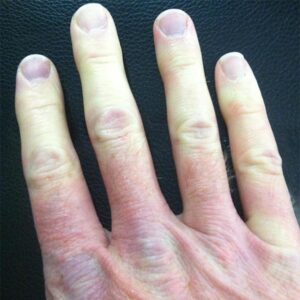
What Is Mixed Connective Tissue Disease?
Mixed connective tissue disease (MCTD), also called undifferentiated connective tissue disease (UCTD), has symptoms of more than one autoimmune connective tissue disease. These include lupus, scleroderma, and myositis. Many people who have mixed connective tissue disease also have inflammatory arthritis and Sjögren’s syndrome. Patients often have a positive ANA (antinuclear antibody) test. Clinicians often view these diseases on a spectrum, and patients may have features of more than one connective tissue disease.
Skin Findings
As far as the skin, patients may have features of cutaneous lupus erythematosus, dermatomyositis, or scleroderma and often do not fit into one diagnosis. Photosensitivity (sensitivity to the sun) is often a hallmark of all types of MCTD/UCTD.
Monitoring and Disease Evolution
Rescreening and clinical monitoring are important over time for systemic symptoms since skin symptoms of one disease, such as dermatomyositis, may evolve to develop internal symptoms consistent with scleroderma. Patients with MCTD/UCTD often don’t fit into a specific diagnosis box. Clinical trials may therefore be challenging. However, and encouragingly, research into the predominant diagnosis (such as findings of cutaneous lupus erythematosus) can be applied to patients with MCTD/UCTD who fit with those symptoms.
Treatment
- Protection from UV light
- Stopping implicated medications
- Control of inflammation with various topical and oral medications, including antimalarial medications (e.g. hydroxychloroquine), and systemic immunosuppressants